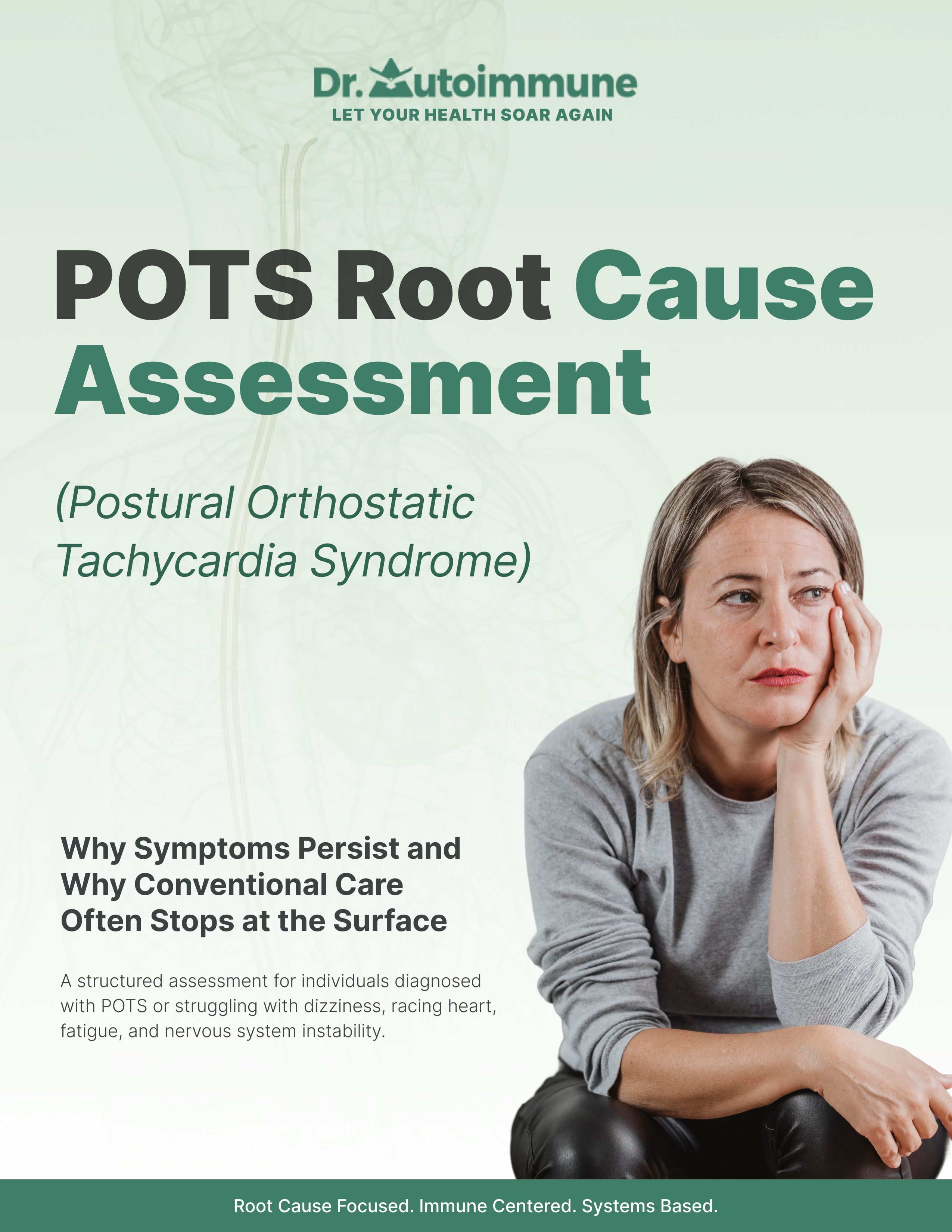
Why Your POTS Symptoms Don’t Add Up

And What Most People Are Never Helped to Connect

A structured self-assessment designed to help identify potential root cause patterns behind symptoms commonly associated with Postural Orthostatic Tachycardia Syndrome (POTS), including dizziness, fatigue, brain fog, racing heart, and nervous system instability.

For individuals diagnosed with POTS or struggling with symptoms that still do not fully make sense.

Root Cause Focused Immune Centered Designed for Complex, Unresolved Symptoms

Why Your POTS Symptoms Don’t Add Up

And What Most People Are Never Helped to Connect

A structured self-assessment designed to help identify potential root cause patterns behind symptoms commonly associated2with Postural Orthostatic Tachycardia Syndrome (POTS), including dizziness, fatigue, brain fog, racing heart, and nervous system instability.

For individuals diagnosed with POTS or struggling with symptoms that still do not fully make sense.

Root Cause Focused Immune Centered Designed for Complex, Unresolved Symptoms

It’s Not Just That You Feel Off


It’s That Nothing Fully Explains It

Maybe you have been diagnosed with POTS.

Or maybe you are still trying to understand why your body suddenly feels different.

You stand up and your heart races.
You feel dizzy in the shower.
You feel exhausted after simple tasks.
You struggle with brain fog, heat intolerance, shortness of breath, or feeling faint.

Some people are told it is anxiety.

Others are told their labs look normal.

Many people are given tools to help manage symptoms.

Increase fluids.
Increase salt.
Wear compression.
Take medication.

And while those approaches can help, many people still feel like something deeper is being missed.

Because the hardest part is not just the symptoms.

It is not understanding why they keep happening.

It’s Not Just

That You Feel Off


It’s That Nothing

Fully Explains It

Maybe you have been diagnosed with POTS.

Or maybe you are still trying to understand why your body suddenly feels different.

You stand up and your heart races.
You feel dizzy in the shower.
You feel exhausted after simple tasks.
You struggle with brain fog, heat intolerance, shortness of breath, or feeling faint.

Some people are told it is anxiety.

Others are told their labs look normal.

Many people are given tools to help manage symptoms.

Increase fluids.
Increase salt.
Wear compression.
Take medication.

And while those approaches can help, many people still feel like something deeper is being missed.

Because the hardest part is not just the symptoms.

It is not understanding why they keep happening.

When Symptoms

Don’t Follow a Clear Pattern

There Is Usually More Going On Beneath the Surface

Postural Orthostatic Tachycardia Syndrome, commonly called POTS, is often described as a condition involving abnormal heart rate changes when standing.

But for many people, the experience feels much bigger than that.

Circulation
Immune
Nervous System
Inflammation

Because the symptoms do not behave like a simple heart issue.

They fluctuate.
They overlap.
They change.

One week feels manageable.

The next feels impossible.

And when symptoms behave unpredictably, it often suggests that more than one system may be involved.

That is where many people begin realizing they may need a different level of investigation.

When Symptoms

Don’t Follow a Clear Pattern

There Is Usually More Going On Beneath the Surface

Postural Orthostatic Tachycardia Syndrome, commonly called POTS, is often described as a condition involving abnormal heart rate changes when standing.

But for many people, the experience feels much bigger than that.

Circulation
Immune
Nervous System
Inflammation

Because the symptoms do not behave like a simple heart issue.

They fluctuate.
They overlap.
They change.

One week feels manageable.

The next feels impossible.

And when symptoms behave unpredictably, it often suggests that more than one system may be involved.

That is where many people begin realizing they may need a different level of investigation.

Most Approaches Focus

on Controlling the Symptoms

Not Investigating Why the Body Changed

Conventional treatment for POTS is typically focused on stabilizing heart rate and circulation.

These tools can help reduce symptoms, but they are not designed to investigate whether deeper patterns may be contributing to the instability in the first place.

Symptom management

The conventional focus is often stabilization.

That may include:

  • Fluids and increased salt intake
  • Compression garments
  • Medication to slow the heart rate
Root cause investigation

But deeper patterns may still be driving instability.

Patterns like:

  • Immune system activation or autoimmune involvement
  • Chronic inflammation
  • Post viral changes
  • Low iron or nutrient depletion
  • Nervous system stress patterns

If the heart is reacting to deeper imbalance, slowing it down may help manage the response without fully explaining why the condition developed.

Because if the underlying drivers are never identified, symptom management can only take you so far.

Most Approaches Focus on Controlling the Symptoms

Not Investigating Why the Body Changed

Conventional treatment for POTS is typically focused on stabilizing heart rate and circulation.

These tools can help reduce symptoms, but they are not designed to investigate whether deeper patterns may be contributing to the instability in the first place.

Symptom management

The conventional focus is often stabilization.

That may include:

  • Fluids and increased salt intake
  • Compression garments
  • Medication to slow the heart rate
Root cause investigation

But deeper patterns may still be driving instability.

Patterns like:

  • Immune system activation or autoimmune involvement
  • Chronic inflammation
  • Post viral changes
  • Low iron or nutrient depletion
  • Nervous system stress patterns

If the heart is reacting to deeper imbalance, slowing it down may help manage the response without fully explaining why the condition developed.

Because if the underlying drivers are never identified, symptom management can only take you so far.

What If Your Symptoms

Are Not Random

But Signals Your Body Has Been Trying to Send

In many cases, the heart is not the starting point.

It is responding.

To stress elsewhere in the system.

That is why symptoms can feel inconsistent and difficult to predict.

You improve for a while.
Then flare again.
You address one symptom.
Then another appears.

For some people, immune system activity may be influencing regulation.

For others, low iron storage may be affecting circulation and oxygen delivery.

Some experience nervous system dysregulation after prolonged stress or illness.

Digestive inflammation and post viral changes can also influence how the body regulates circulation, stress response, and energy production.

When multiple systems overlap, symptom management alone often does not create lasting stability.

The real question is not just how to calm the symptoms.

It is why the body became unstable in the first place.

What If Your Symptoms

Are Not Random

But Signals Your Body Has Been Trying to Send

In many cases, the heart is not the starting point.

It is responding.

To stress elsewhere in the system.

That is why symptoms can feel inconsistent and difficult to predict.

You improve for a while.
Then flare again.
You address one symptom.
Then another appears.

For some people, immune system activity may be influencing regulation.

For others, low iron storage may be affecting circulation and oxygen delivery.

Some experience nervous system dysregulation after prolonged stress or illness.

Digestive inflammation and post viral changes can also influence how the body regulates circulation, stress response, and energy production.

When multiple systems overlap, symptom management alone often does not create lasting stability.

The real question is not just how to calm the symptoms.

It is why the body became unstable in the first place.

This Assessment Was Designed

to Help You Start Connecting the Dots

POTS Root Cause Assessment Mockup

The POTS Root Cause Assessment is not a diagnosis.

It is a structured pattern recognition tool designed to help you begin identifying whether your symptoms may be connected to more than one system.

Inside, you will walk through patterns commonly seen in complex chronic cases, including:

Nervous system regulation patterns
Immune and post viral patterns
Iron and nutrient patterns
Digestive and inflammatory patterns
Circulation patterns

Because for many people, the issue is not one isolated problem.

It is the interaction between systems.

This Assessment

Was Designed

to Help You Start Connecting the Dots

POTS Root Cause Assessment Mockup

The POTS Root Cause Assessment is not a diagnosis.

It is a structured pattern recognition tool designed to help you begin identifying whether your symptoms may be connected to more than one system.

Inside, you will walk through patterns commonly seen in complex chronic cases, including:

Nervous system regulation patterns
Immune and post viral patterns
Iron and nutrient patterns
Digestive and inflammatory patterns
Circulation patterns

Because for many people, the issue is not one isolated problem.

It is the interaction between systems.

What You May Begin to Understand

From This Assessment

01

Why your symptoms seem unpredictable

02

Why symptom-based approaches may not have fully worked

03

Whether more than one system may be contributing to your instability

04

Why immune, inflammatory, nervous system, and metabolic patterns may overlap

05

What your symptoms may be trying to reveal beneath the surface

06

And why the next step may require a deeper level of investigation

What You May Begin

to Understand

From This Assessment

01

Why your symptoms seem unpredictable

02

Why symptom-based approaches may not have fully worked

03

Whether more than one system may be contributing to your instability

04

Why immune, inflammatory, nervous system, and metabolic patterns may overlap

05

What your symptoms may be trying to reveal beneath the surface

06

And why the next step may require a deeper level of investigation

When the Missing Pieces

Start Coming Together

Patient Story
My anxiety is gone. I have more energy than I’ve had in over a decade.

Before working with Dr. Ian, I hit a breaking point. I collapsed at work and spent almost a month in bed. I felt terrified and overwhelmed.

Within a few months, he identified triggers that had been missed and created a clear, structured plan.

My anxiety is gone. I have more energy than I’ve had in over a decade, and my nervous system has stabilized.

Emily R.

When the Missing Pieces

Start Coming Together

Patient Story
My anxiety is gone. I have more energy than I’ve had in over a decade.

Before working with Dr. Ian, I hit a breaking point. I collapsed at work and spent almost a month in bed. I felt terrified and overwhelmed.

Within a few months, he identified triggers that had been missed and created a clear, structured plan.

My anxiety is gone. I have more energy than I’ve had in over a decade, and my nervous system has stabilized.

Emily R.

A Different Approach

for Complex, Unresolved Symptoms

Dr. Ian Hollman

Dr. Ian Hollman, DC, MSc, FMCP, has spent more than 17 years helping individuals with chronic, complex health conditions that have not improved with standard approaches.

His work focuses on identifying patterns that may be contributing to instability beneath the surface.

Rather than applying one size fits all protocols, Dr. Ian uses a structured investigative approach designed to evaluate how different systems in the body may be interacting.

This includes immune activity, inflammation, nervous system regulation, digestion, nutrient status, and circulation patterns.

Because when the pattern becomes clear, the strategy becomes more targeted.

17+ Years Experience
Complex Chronic Cases
Telehealth Nationwide Support

A Different Approach

for Complex, Unresolved Symptoms

Dr. Ian Hollman

Dr. Ian Hollman, DC, MSc, FMCP, has spent more than 17 years helping individuals with chronic, complex health conditions that have not improved with standard approaches.

His work focuses on identifying patterns that may be contributing to instability beneath the surface.

Rather than applying one size fits all protocols, Dr. Ian uses a structured investigative approach designed to evaluate how different systems in the body may be interacting.

This includes immune activity, inflammation, nervous system regulation, digestion, nutrient status, and circulation patterns.

Because when the pattern becomes clear, the strategy becomes more targeted.

17+ Years Experience
Complex Chronic Cases
Telehealth Nationwide Support

If Your Symptoms Still

Don’t Fully Make Sense

This Is Where to Start

You do not need another temporary fix.
You need clarity.

This assessment was designed to help you begin identifying what may actually be contributing to your symptoms and why they may not be improving.

01 Download it.
02 Walk through it.
03 Start connecting what has not made sense until now.
Free structured self-assessment for complex, unresolved POTS symptoms.

If Your Symptoms

Still Don’t Fully Make Sense

This Is Where to Start

You do not need another temporary fix.
You need clarity.

This assessment was designed to help you begin identifying what may actually be contributing to your symptoms and why they may not be improving.

01 Download it.
02 Walk through it.
03 Start connecting what has not made sense until now.
Free structured self-assessment for complex, unresolved POTS symptoms.